[comment]: # (mdslides presentation.md --include media) [comment]: # (The list of themes is at https://revealjs.com/themes/) [comment]: # (The list of code themes is at https://highlightjs.org/) [comment]: # (markdown: { smartypants: true }) <style type="text/css"> .reveal { font-size: 2.2em; } .reveal .code-wrapper code { white-space: pre; font-size: 2em; line-height: 1.2em; } </style> Microservices23 # Microservices - Fault tolerance and service resiliency architectures By Alon Itach
## Health checks Sometimes a service can be incapable of handling requests yet still be running. For example, it might have ran out of database connections. 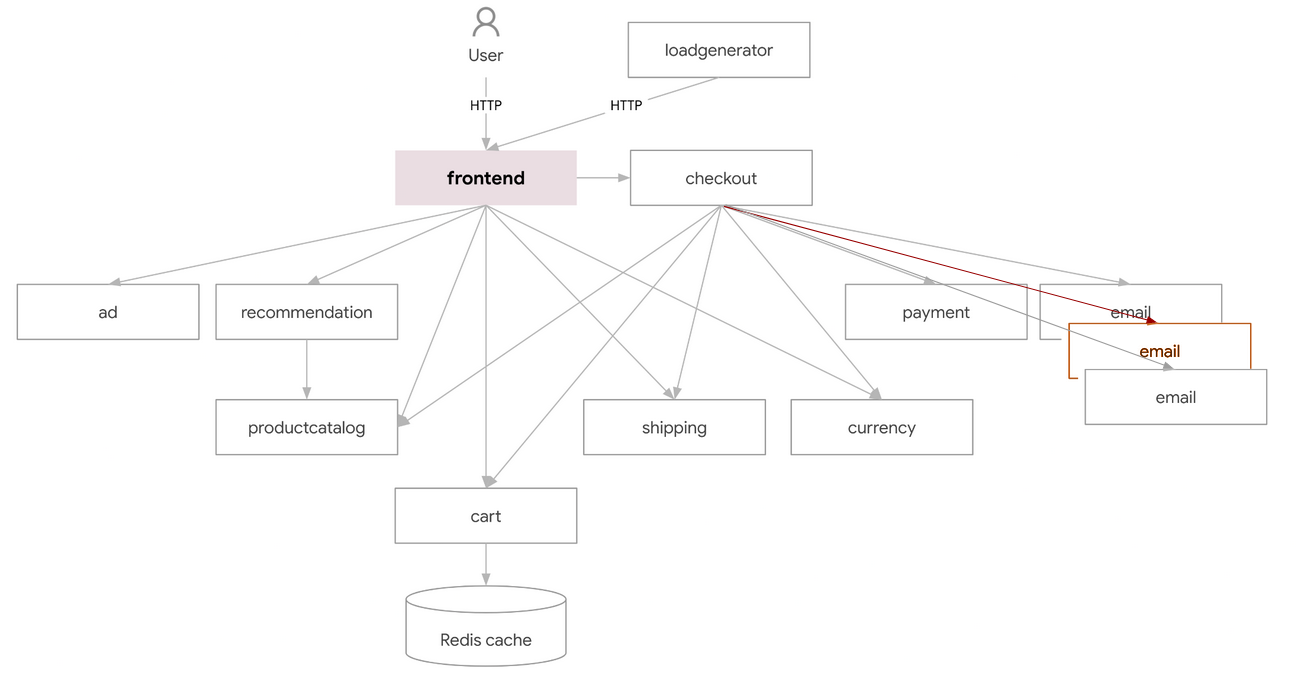
## Health checks When this occurs, (1) the monitoring system should generate a alert, and (2) traffic should not be routed to the failed service. 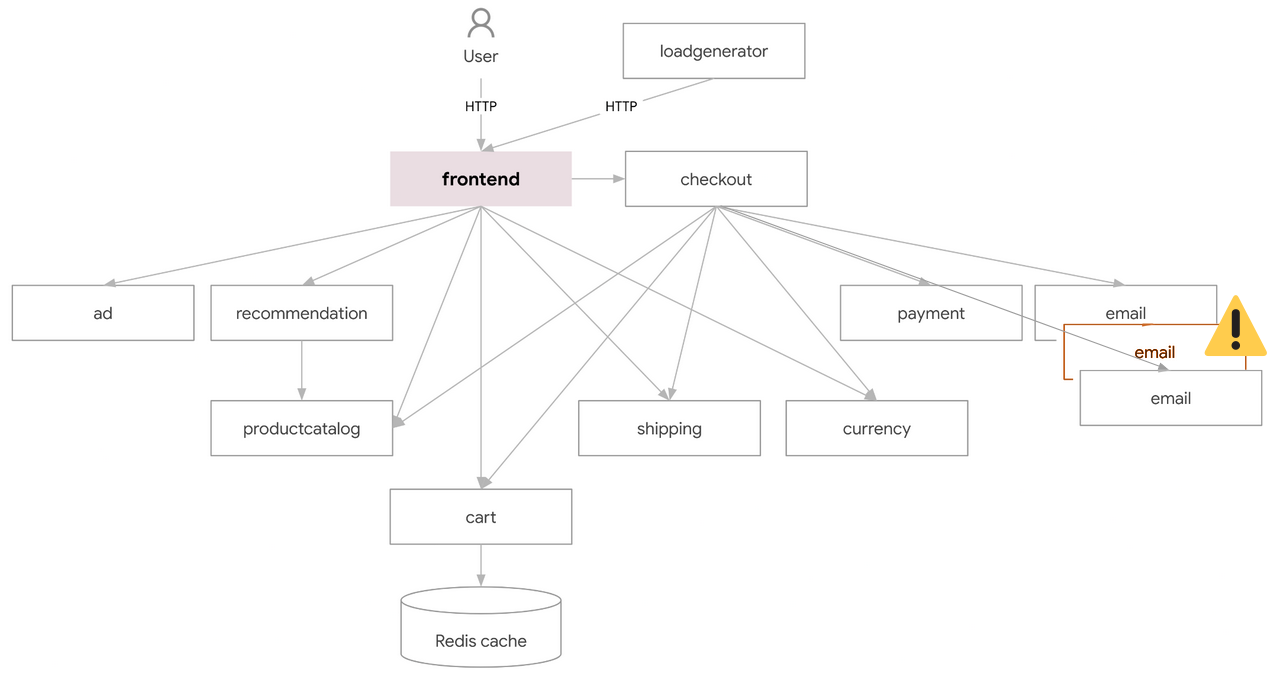
## Health checks - Implementation details A service has an health check API endpoint (e.g. HTTP `/health`) that returns the health of the service. The API endpoint handler performs various checks, such as: - The status of the connections to the infrastructure services used by the service instance - The status of the host, e.g. disk space - Application specific logic Someone (the **kubelet** in the case of k8s cluster) should periodically invoke the endpoint to check the health of the service instance.
## Service consistency Each microservice has its own database. Some business transactions, however, span multiple service so you need a mechanism to implement transactions that span services.
## Service consistency - Example Use-case: Placing an order in the Online Boutique service requires 5 steps 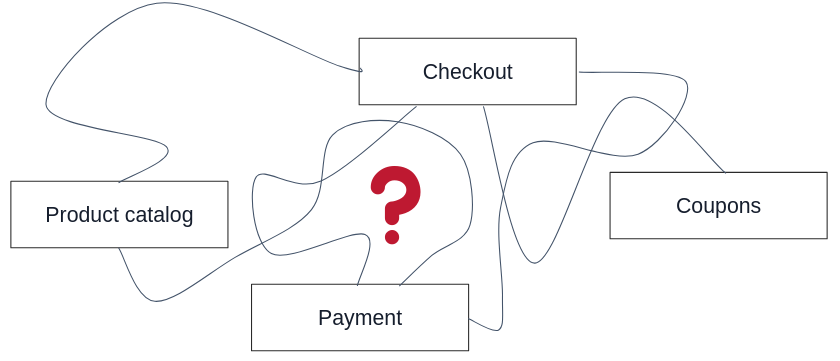 - Create an order using the **Checkout** service - Check product availability and lock the order in the **Product Catalog** service - Apply a discount using the **Coupon** service - Create a money transaction in the **Payment** service
## Service consistency - Example In the **monolithic app**, there is a single database in which we can create an **atomic transaction**. Either all steps occur, or none occur.
## Service consistency - Example How to implement transactions that span multiple microservices? 
## Service consistency - Example There are 2 approaches: **Process Manager**, **Saga**
## Service consistency - Example - Process manager 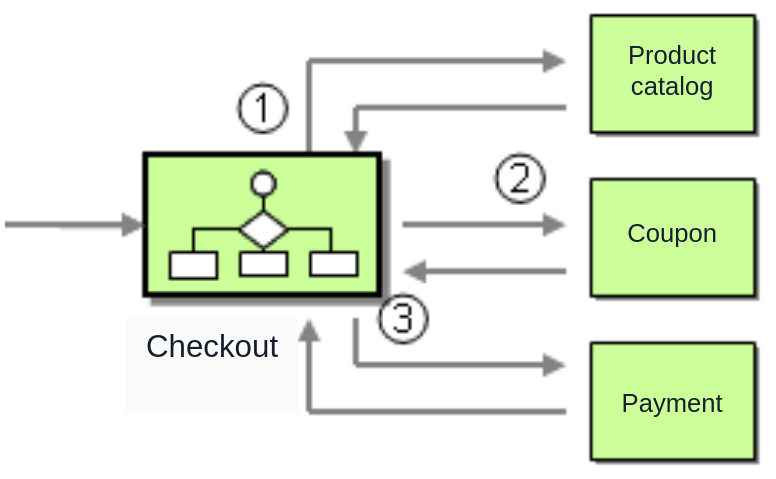 There is a centralized microservice (the **Checkout** service in our case) that coordinates the business logic according to finite state machine. The process manager maintains the state of the sequence (usually using its wn db) and determine the next processing step based on intermediate results.
## Service consistency - Example - Process manager - Easier to understand and debug. - The programming model is more complex - developers have to code compensating transactions that explicitly undo changes if local transaction fails. - Overtime the process manager service might turn into a monolith.
## Service consistency - Example - Saga A Saga is a distribution of multiple workflows across multiple services, each providing a path of **compensating actions** in the event that any of the steps in the workflow fails. 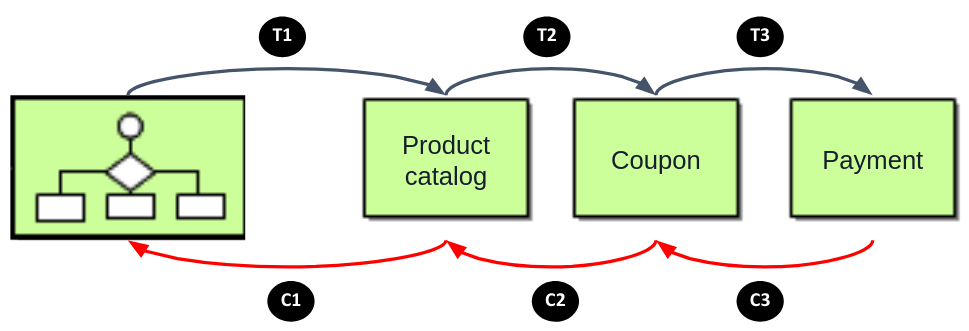
## Service consistency - Example - Saga - Simple logic - each service has to care its own transaction and compensation actions - Sometimes hard to debug
## Request design - Retry - **Automatic Retries**: Implement a retry mechanism for failed requests - **Exponential Backoff**: Gradually increase the time between retries to prevent overwhelming the system in case of transient failures. - **Retry Budget**: Set a limit on the number of retries to avoid infinite loops and excessive resource consumption.
## Request design - Timeout - **Define Timeouts**: Establish well-defined timeouts for each service-to-service interaction. - **Graceful Timeout Handling**: Gracefully handle timeouts by providing appropriate responses or fallback mechanisms.
## Request design - Circuit Breaker In microservices, the failure of one service can potentially cascade to other services throughout the application. <br><br> How?
## Request design - Circuit Breaker When one service synchronously invokes another there is always the possibility that the other service is unavailable. Precious resources such as threads might be consumed in the caller while waiting for the other service to respond. This might lead to resource exhaustion, which would make the calling service unable to handle other requests.
## Request design - Circuit Breaker The solution: a **Circuit Breaker** mechanism A service client should invoke a remote service via a proxy that functions in a similar fashion to an electrical circuit breaker. When the number of consecutive failures crosses a threshold, the circuit breaker trips, and for the duration of a timeout period all attempts to invoke the remote service will fail immediately.
# Thanks References: - https://microservices.io/patterns/observability/health-check-api.html - https://microservices.io/patterns/data/saga.html - https://microservices.io/patterns/reliability/circuit-breaker.html